
// Security Was a Checkbox. In 2026, It's the Product.
The Agents Are Working.
Who's Watching the Agents?
How AI is reshaping VAPT, penetration testing, cloud, mobile, web and API security: what got better, what got more dangerous, and why the human element matters more now, not less.
If AI is now doing the work, who is making sure the AI is doing it right?
// Agent Oversight Console
LIVEAgents Online
12
Actions Reviewed
2,481
Flagged Today
3
// 01 · The Stakes
A Board-Level Problem, Not an IT Ticket
The "annual audit, clean certificate" model is dangerously out of date. The numbers make the case.
$4.44M
Average cost of a data breach (IBM, 2025)
−$2.2M
Saved by orgs using AI & automation in security ops, though only ~2/3 have it
78% / 84%
Orgs using gen-AI in a business function / devs using AI tools daily
+$29B
Projected rise in 2026 security budgets from AI-governance issues (Gartner)
Security is no longer a cost center to minimize; it's now part of the reliability and trust your software is built on. A single agentic AI with the wrong permissions can move faster than your incident response plan, and customers, regulators and insurers will hold you responsible, not the model.
// 02 · The Upside
What AI Genuinely Made Better
Real, measurable gains, not hype.
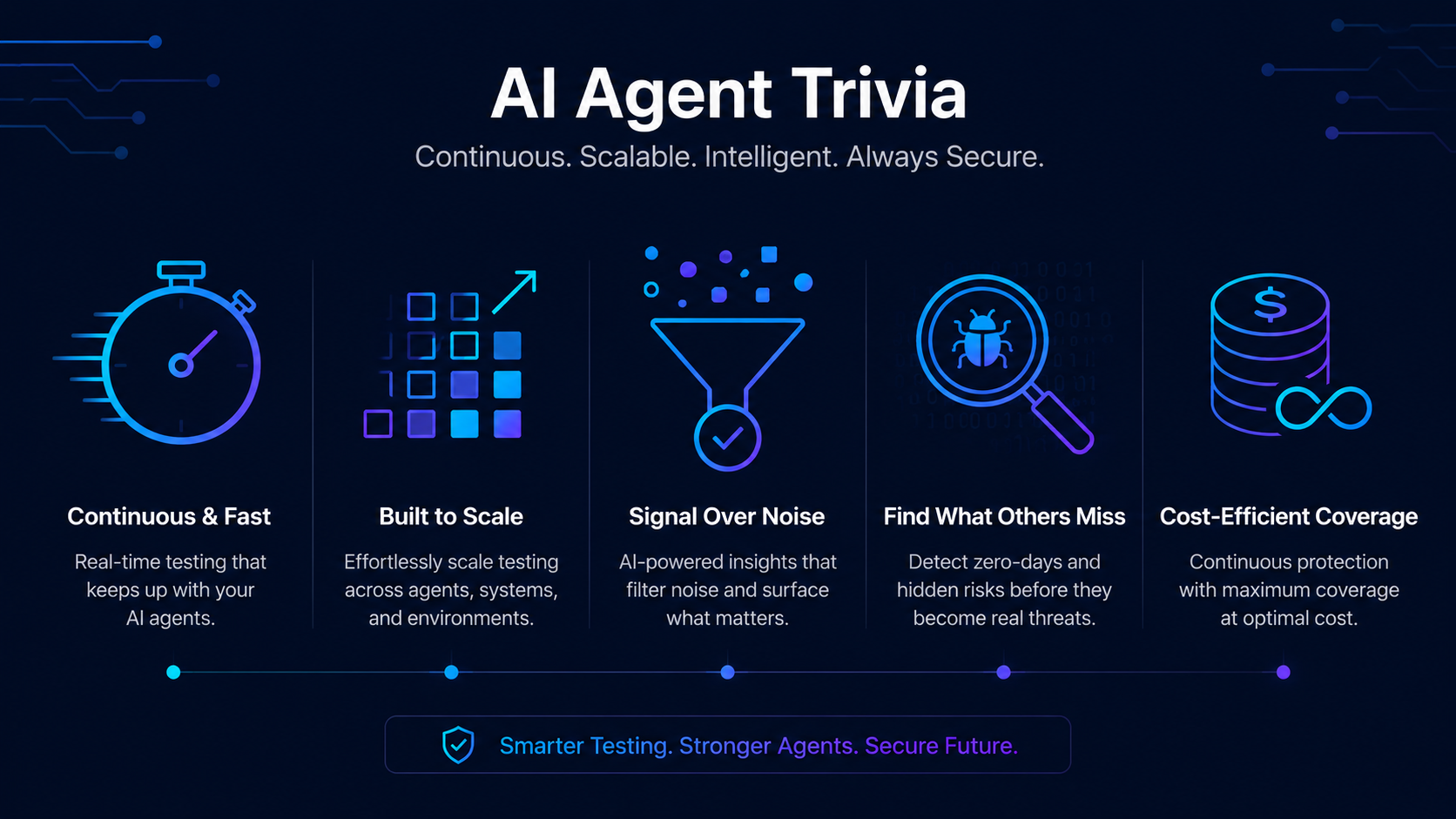
Shrinks the Exposure Window
Continuous re-testing on every code change means the gap between "introduced" and "found" drops from months to minutes.
Scale No Human Team Matches
Dozens of weekly releases, thousands of endpoints, real-time log review: AI absorbs the volume.
Less Noise, Sharper Signal
Old scanners drowned teams in 20–30% false positives. AI validates exploitability first, so engineers fix what matters.
Finds What Humans Miss
DeepMind's CodeMender and similar agents surface genuine zero-days in mature, well-reviewed software.
Always-On, Lower Cost
A pentest runs $10K–$100K+ with retests billed extra. AI gives continuous baseline coverage between engagements.
// 03 · The Downside
What Got More Dangerous
The same tech that strengthened defense handed attackers a loaded weapon, and created a new internal risk.
48%
Top attack vector, 2026
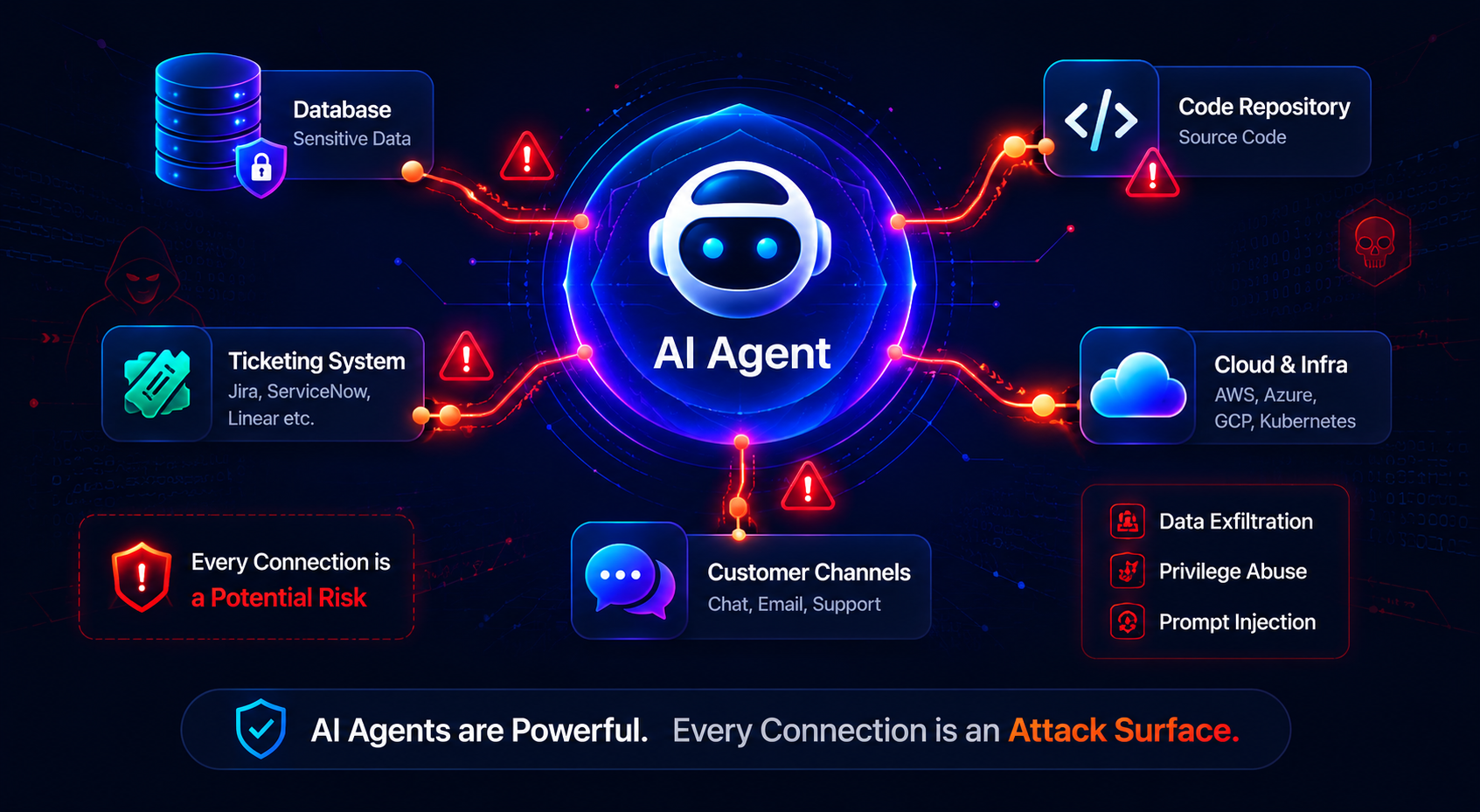
Your AI Agents Are Your Biggest Attack Surface
48% of security pros rank agentic AI the #1 attack vector (Dark Reading); 92% are concerned about AI agent impact (Darktrace). Agents act autonomously with elevated access to databases, repos, tickets and cloud, often with minimal review.
Attackers Have Your Tools Too
Phishing, exploit generation and vulnerability discovery now run at machine speed on both sides of the wall.
New Attack Classes
Prompt injection is #1 on the OWASP LLM Top 10. Add tool misuse, privilege escalation, memory poisoning and data poisoning, none of which a traditional scanner catches.
87%
Failures Cascade in Hours
One compromised agent poisoned 87% of downstream decisions within 4 hours in Galileo's Dec-2026 multi-agent study. The root cause stays invisible while symptoms multiply.
24%
Shadow AI, No Governance
Every agent creates a non-human identity legacy IAM wasn't built for, yet only 24% of enterprises have a dedicated AI governance team.
// 04 · The Question
Who Is Watching the Agents?
We deployed AI agents to cut human workload, and removed human eyes from the systems with the most power and broadest access. An agent that opens pull requests, queries production data, triggers deployments and messages customers, with minimal human involvement, is a system whose decisions no one fully reviews in real time.
When it goes wrong, there's no actor to catch on camera, just a chain of small, individually-reasonable automated decisions adding up to a breach.
Not "more AI to watch the AI": stacking autonomy multiplies blind spots.
Deliberate human oversight at the decisions that matter.
// 05 · The Human Element
Why the Human Element Matters MORE, Not Less
AI won't replace security teams; the evidence points the other way: 82% of exploited vulnerabilities involved human reasoning and contextual analysis (Verizon DBIR), exactly where automation is weakest.
Three things AI still can't do:
Understand Context & Intent
Only a human knows which "low-severity" finding processes your highest-value payments, and which of a thousand flags becomes front-page news.
Find Business-Logic Flaws
Privilege escalation, BOLA, workflow bypasses: these come from understanding intended behavior and breaking it creatively. Human work, by human attackers.
Be Accountable
SOC 2, PCI DSS, HIPAA, ISO 27001 and the EU AI Act (Aug 2026) all require human-signed assessments. A machine can't take responsibility.
AI removes the grunt work so your best people focus on high-judgment problems and agent oversight. The role is changing, not disappearing: AI-security roles are among the highest-paid in 2026, and demand for AI red-teaming is projected to surge 35% by 2028.
// 06 · The Model
The Hybrid Model
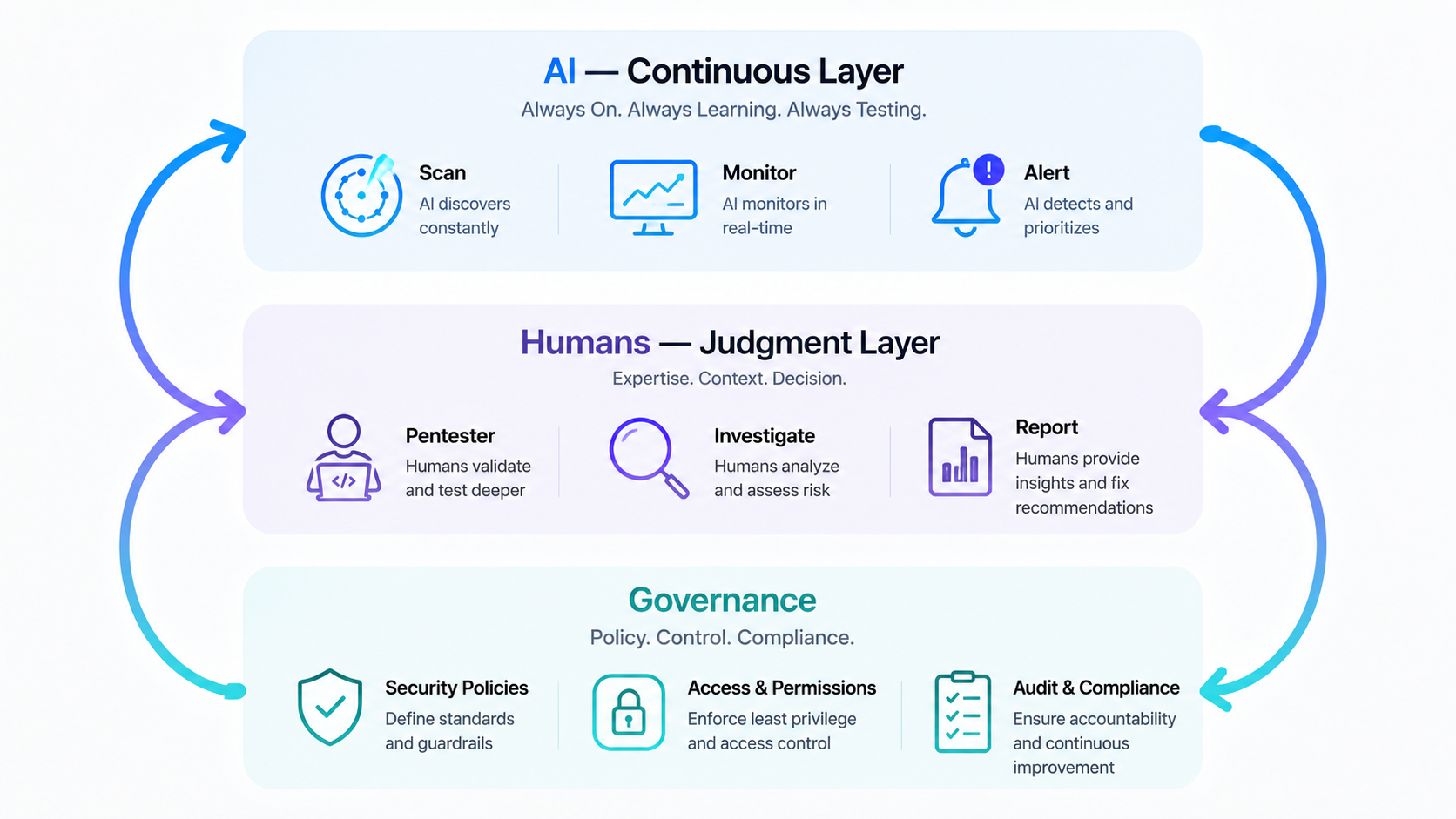
Stop arguing "AI vs. humans." Build a system where each does what it's best at, closed in a continuous loop.
AI: The Continuous Layer
24/7 scanning, anomaly detection, automated triage, instant re-tests on every change. Never tired, infinitely scalable.
Humans: The Judgment Layer
Validate findings, run red-team simulations, hunt logic flaws, make the risk calls, sign the compliance reports.
Governance: The Glue
Own every agent's permissions, track non-human identities, set human checkpoints at decisions that matter. We call this "DevSecEng."
// 07 · Service by Service
Across Your Security Stack
AI handles breadth and frequency, while experts handle depth, logic flaws and sign-off, everywhere.
VAPT
AI: continuous discovery & validation at scale. Human: exploit chains, logic flaws, sign-off.
Enterprise VAPT GuidePenetration Testing
AI now chains exploits dynamically, "autonomy," not just automation. Human-signed reports stay mandatory in regulated industries.
Cloud Security
AI flags misconfigs & drift early in CI/CD. New frontier: securing AI workload identities themselves.
Cloud Security ChecklistMobile App Security
AI keeps pace with app-store release cycles. Human review still catches platform-specific privacy issues automation reads as "passing."
Mobile Security ChecklistWeb Application Testing
AI adapts in real time, cuts false positives. Broken auth, IDOR & workflow bypasses still need human reasoning.
Web App Security ChecklistAPI Testing
High-volume, ideal for AI-driven continuous testing. Human validation for business-logic & cross-service authorization.
API Security Best PracticesDevSecOps → DevSecEng
Security shifts left, with AI triaging SAST/DAST and suggesting fixes in-pipeline. Critical guardrail: never ship AI output without a human review gate.
DevSecOps Checklist// 08 · The Bottom Line
By Role
A breach is now a board-level, balance-sheet event. AI lowers your cost of defense, but only if you also fund human oversight that stops your own AI from becoming the threat.
The hybrid model isn't optional. Build continuous AI testing into your pipeline, inventory every agent, govern its permissions like a privileged user, and add human checkpoints.
AI handles the volume. Your edge is context, creativity and thinking like an attacker who understands the business; that's still what catches the flaws that matter.
Security That Thinks at Machine Speed and Judges Like a Human.
AI-driven continuous testing across web, mobile, cloud and API, backed by certified human experts who own the judgment and the accountability. We secure your applications and the AI inside them, because someone has to watch the agents.
ISO 9001 & ISO 27001 certified · 10+ years · 500+ clients across India, the UAE, the US, the UK & Australia